
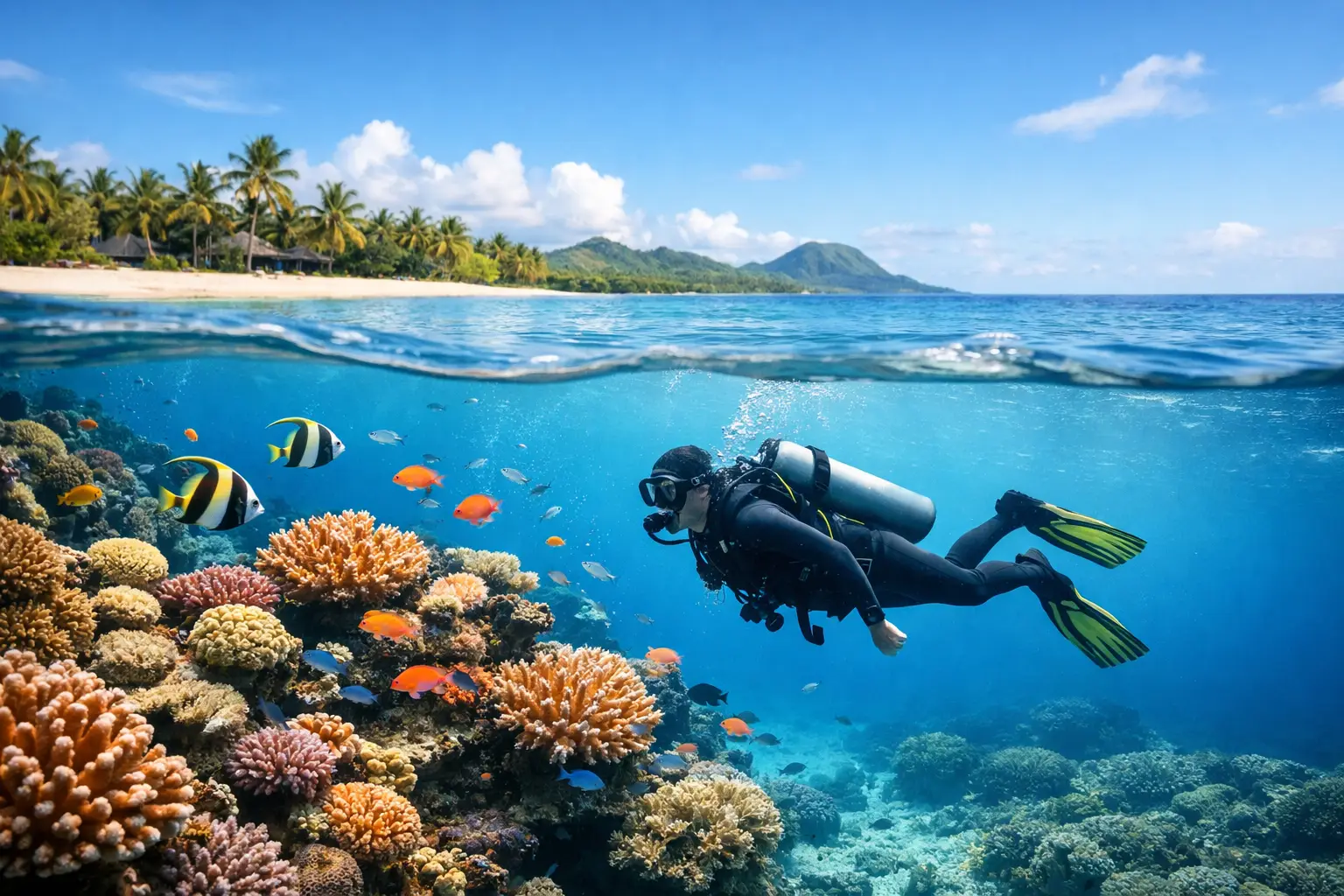
The best underwater day in Mauritius can begin just minutes from shore: a boat leaving Flic en Flac at first light, a volcanic wall dropping into blue water, and schools of fish moving through the reef below. The top Mauritius diving sites are wonderfully varied for a compact island. You can choose gentle coral gardens for a first ocean dive, dramatic caverns for experienced divers, historic wrecks, and outer-island sites where the open ocean brings bigger marine encounters.
Mauritius is not a destination where one site suits everyone. Sea conditions, your certification level, recent experience, and where you are staying all matter. Planning with a trusted local operator helps keep boat transfers, timing, and dive selection simple, so your holiday stays relaxed from the first briefing to the last rinse of your gear.
Top Mauritius Diving Sites by Experience
Cathedral, Flic en Flac
Cathedral is one of the west coast’s signature dives and earns its name from its immense volcanic rock formations. Swim-throughs, arches, overhangs, and shafts of sunlight create a striking underwater landscape. The reef is alive with moray eels, scorpionfish, trumpetfish, batfish, and, on a fortunate day, larger pelagic visitors passing through the blue.
This is generally best for confident certified divers who are comfortable with changing depth and navigating around rock structures. Conditions can be calm and inviting, but the site has real depth and its beauty is best appreciated at an unhurried pace. Cathedral is an excellent choice for travelers based around Flic en Flac who want a memorable advanced-style reef dive without a long day of travel.
The Stella Maru Wreck, Trou aux Biches
A wreck dive has a different kind of appeal. The Stella Maru, intentionally sunk off the north coast, has become an artificial reef covered in marine growth and busy with fish life. Divers often see lionfish, groupers, moray eels, and schools gathering around the structure. Its recognizable outline also makes it especially rewarding for underwater photographers.
The wreck is commonly suited to open-water certified divers, though conditions and the planned route determine whether it is right for a particular group. Penetration should only be considered with appropriate training, equipment, and a guide who has assessed the day’s conditions. Even without entering the wreck, circling its exterior offers a fascinating, accessible experience.
Coin de Mire, Near Grand Baie
Coin de Mire, the dramatic islet north of Mauritius, is a favorite area for divers looking for clear water and a sense of open-ocean adventure. The island’s underwater slopes, caves, and rock faces offer several distinct sites rather than one single dive. Visibility can be excellent, and the scenery often feels wilder than the sheltered lagoons closer to shore.
Marine life may include turtles, rays, large schools of fish, and seasonal pelagic species. Some sites around Coin de Mire are appropriate for intermediate divers, while others require more experience because of depth, current, or surface conditions. This is where local judgment is particularly valuable: a great boat captain and dive team will select the right side of the island for the weather, rather than forcing a plan that does not fit the sea.
Snake Island and Round Island
For experienced divers, the northern offshore islands provide some of Mauritius’s most exciting underwater terrain. The sea can be deeper and more exposed, with currents that attract larger fish and create exceptional blue-water views. These sites are often associated with reef sharks, eagle rays, tuna, and vast schools moving along the drop-offs.
The trade-off is straightforward: this is not the place to stretch beyond your comfort zone. Offshore trips depend on weather, swell, and operator assessment, and they can be canceled or redirected for good reason. Divers with solid buoyancy control and recent experience will get the most from these sites. If conditions align, the experience can be one of the standout memories of a Mauritius holiday.
Hoi Siong Wreck, West Coast
The Hoi Siong is another purpose-sunk wreck, located off the west coast and known for its photogenic framework and resident marine life. Over time, the vessel has become part of the reef environment, with colorful soft corals, schooling fish, and small creatures tucked into every corner.
It is often a strong option for divers who want to progress beyond shallow reef dives while staying close to the coast. As with any wreck, depth limits, current, and visibility should guide the day’s plan. Ask your dive professional whether the site suits your certification and whether a second, shallower reef dive would make the better pairing.
Rempart Serpent and the West Coast Reefs
The west coast has more to offer than its famous caverns and wrecks. Reef sites such as Rempart Serpent provide volcanic ridges, coral-covered sections, and steady fish activity that can suit a broad range of certified divers. These dives can feel more relaxed than an offshore expedition while still delivering the color and variety travelers expect from the Indian Ocean.
They are also useful for families or couples with different confidence levels. One person may prefer a straightforward reef dive, while another wants a deeper or more challenging site on a separate outing. A flexible plan lets everyone enjoy the water without turning a vacation activity into a test of nerve.
What You May See Underwater
Mauritius offers a rich mix of reef and open-water life rather than one guaranteed headline animal. Expect to look closely for nudibranchs, pipefish, leaf fish, crabs, and shrimps on the reef, then look outward for turtles, stingrays, eagle rays, barracuda, jacks, and larger schools. Whitetip reef sharks can appear at selected sites, particularly on deeper or offshore dives, but wildlife is never a promise.
That unpredictability is part of the experience. A quiet dive with perfect visibility and intricate reef life can be just as rewarding as a day with larger animals. Tell your guide what interests you most, whether that is photography, wrecks, turtles, wide-angle scenery, or a gentle first dive. The right site selection makes a meaningful difference.
When to Plan Your Mauritius Diving Trip
Diving is possible throughout the year, but the experience changes with the seasons. The warmer months, generally from November through April, bring warmer water and can offer excellent marine activity. They also overlap with the cyclone season, when weather patterns can be less predictable. The cooler, drier period from May through October may bring slightly cooler water, often around the mid-70s Fahrenheit, and can be comfortable with the right exposure protection.
Visibility, wind, and current vary by coast and by day. The west and north are often practical choices during the southeast trade-wind season, while the east can be attractive when conditions settle. Instead of booking every dive before you arrive, leave some room for local recommendations. A team monitoring the sea daily can match your trip to the best available conditions.
A Simple Way to Plan the Right Dives
Start with honesty about your certification and recent dive history. If you have not been underwater for a year or more, a refresher or an easy first dive is a smart way to regain comfort. Bring certification proof and logbook details if you have them, and let the team know about medical considerations well before departure.
Build diving around the rest of your holiday rather than treating it as an isolated excursion. Allow enough time between your final dive and flying, especially if you plan multiple dives. Consider where you are staying, how early you are happy to leave, and whether non-diving companions need a parallel activity. Discovering Mauritius can help coordinate transport and day plans around your chosen area, making it easier to enjoy the island above and below the surface.
A great Mauritius dive is not necessarily the deepest, most remote, or most demanding site on the map. It is the one that fits your ability, the day’s conditions, and the kind of memory you came to make.